
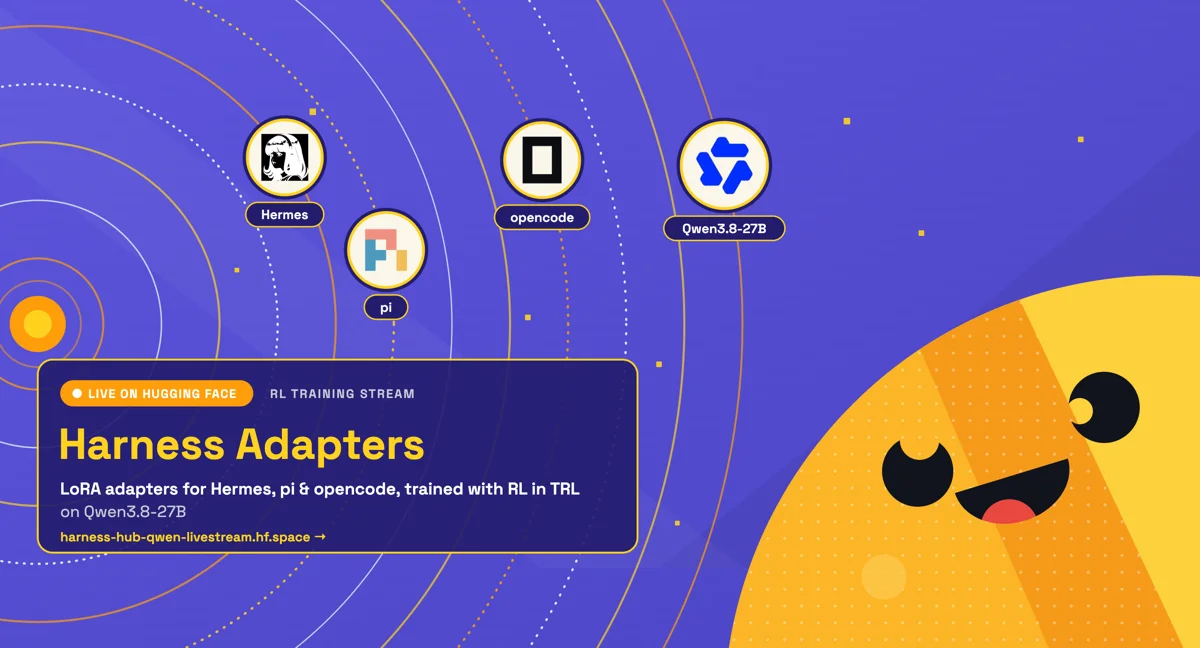
Introducing Harness Adapters: Adapt Your Favorite Model to Your Harness to Improve Performance and Cost
- Qwen3.8-27B
- Pi
- OpenCode
- Hermes Agent
- TRL
- OpenEnv
- Harbor
- vLLM
AI Summary
This article introduces harness adapters, which are RL-trained LoRA adapters designed to optimize large language models for specific agent harnesses and task distributions. By training models inside actual agent harnesses using TRL's AsyncGRPOTrainer and OpenEnv, the authors demonstrate significant improvements in accuracy and token efficiency on software engineering tasks. For example, Qwen3.8-27B achieves a higher pass rate with fewer tokens using these custom adapters compared to the base model. The post covers generating custom tasks, validation, training setups using NVIDIA GPUs, merging multiple adapters into a single super-adapter, and open-source recipes for reproduction.
Key Takeaways
- Trained LoRA adapters for Qwen3.8-27B inside specific agent harnesses (pi, Hermes Agent, OpenCode) using RL.
- Utilized TRL's AsyncGRPOTrainer, OpenEnv, Harbor, and Tasksmith for task generation and validation.
- Demonstrated that adapters can be merged into a single multi-harness super-adapter.
Why it matters
Optimizing language models for specific deployment agent harnesses rather than general performance unlocks hidden efficiency, reducing token usage and improving first-time success rates on coding and software engineering tasks. Providing a fully reproducible recipe allows engineering teams to tailor open models to their specific workflows and tools.
Conversation0
What would you add from your experience?
Checking your session…
Every good conversation starts with one perspective.