
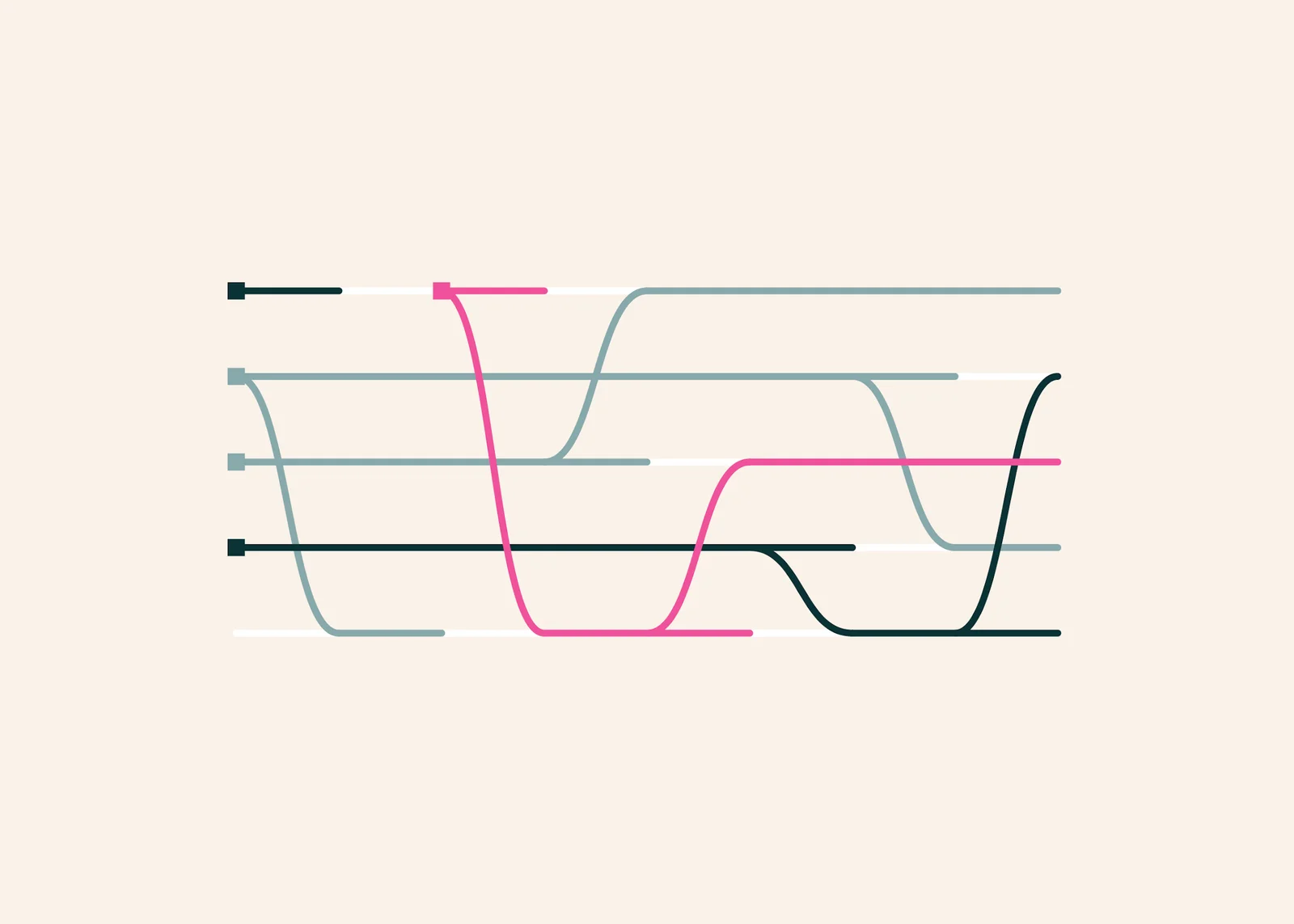
StateBench: Testing how language models track state changes over long documents
- Gemini 3.8 Flash
- Claude Opus 5.5
- GPT-6 Sol and Luna
- Olmo 3
- Olmo Hybrid
- Gated DeltaNet
AI Summary
StateBench is a new benchmark designed to evaluate how well language models track state changes across long documents. It features four distinct difficulty levels based on Krohn-Rhodes theory, ranging from r-trivial to general finite problems. Evaluations reveal that while recurrent and hybrid models like Gated DeltaNet generalize well when trained directly, standard transformers struggle with long dependency chains and fail entirely on the hardest state-tracking levels.
Key Takeaways
- StateBench incorporates four levels of state-tracking complexity: r-trivial, aperiodic, soluble, and general finite.
- Evaluations show that Gated DeltaNet and hybrid architectures generalize significantly farther than transformers on longer sequences when trained directly.
- Frontier models like Gemini 3.8 Flash, Claude Opus 5.5, and GPT-6 Sol and Luna experience sharp drops in accuracy on soluble and general finite problems as input lengths grow.
Why it matters
As language models are increasingly used for tasks requiring long-context reasoning—such as code execution and narrative tracking—understanding architectural limitations in state tracking is vital. StateBench provides engineers and researchers with a fine-grained tool to assess where models break down and how alternative architectures like Gated DeltaNet compare to transformers.


Conversation0
What would you add from your experience?
Checking your session…
Every good conversation starts with one perspective.