
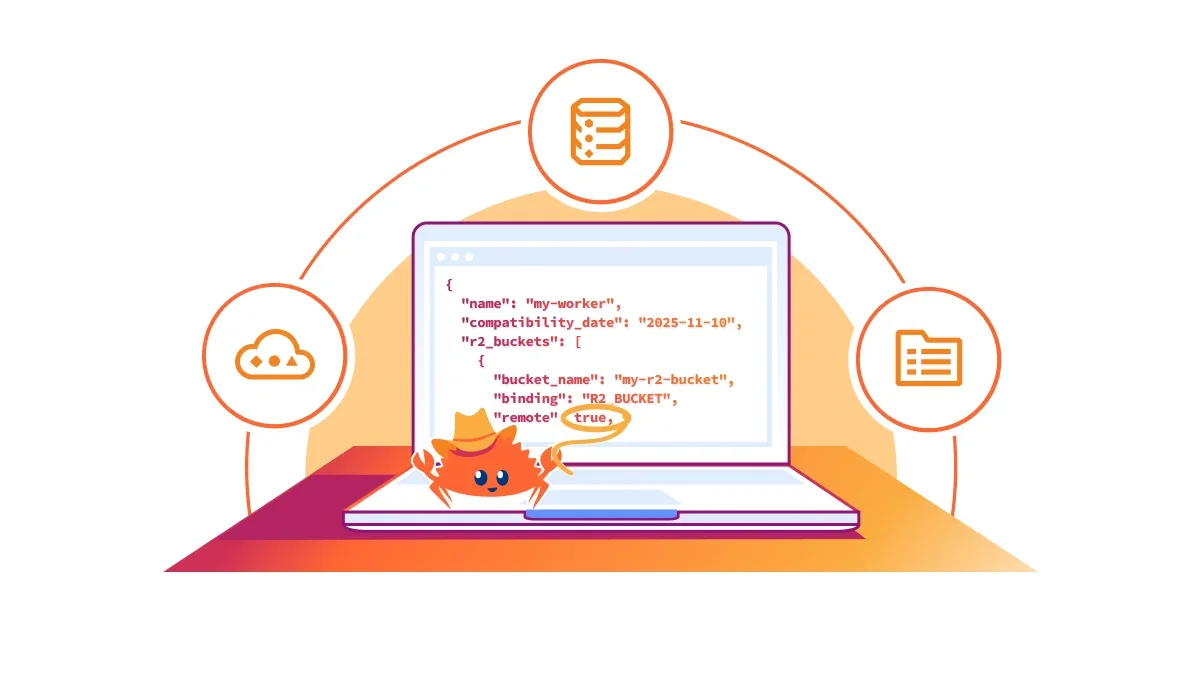
Connecting to production: the architecture of remote bindings
7 similar posts
- Cloudflare Workers
- Wrangler
- Miniflare
- Cloudflare Vite Plugin
AI Summary
Cloudflare has introduced remote bindings, enabling developers to connect local Cloudflare Workers to live production resources such as R2 buckets and D1 databases. By leveraging existing production service bindings and a remote proxy architecture utilizing HTTP and JSRPC over WebSockets via Cap'n Web, developers can selectively route specific bindings to production data without abandoning their local development environments.
Key Takeaways
- Remote bindings can be enabled on a per-binding basis by adding `remote: true` in Wrangler config v4.37.0 or newer.
- The architecture builds upon natural network boundaries, routing local runtime (workerd) calls through a remote proxy client and server to the actual production resources.
- Modern JSRPC-backed bindings (like Images and service bindings) are supported using WebSockets powered by Cap'n Web.
Why it matters
Remote bindings bridge the gap between local development speed and production confidence, allowing engineers to test code against real data and services per binding without maintaining complex API key management or deploying on every iteration.

Conversation0
What would you add from your experience?
Checking your session…
Every good conversation starts with one perspective.