
Implementing a Local-First Task Framework
AI Summary
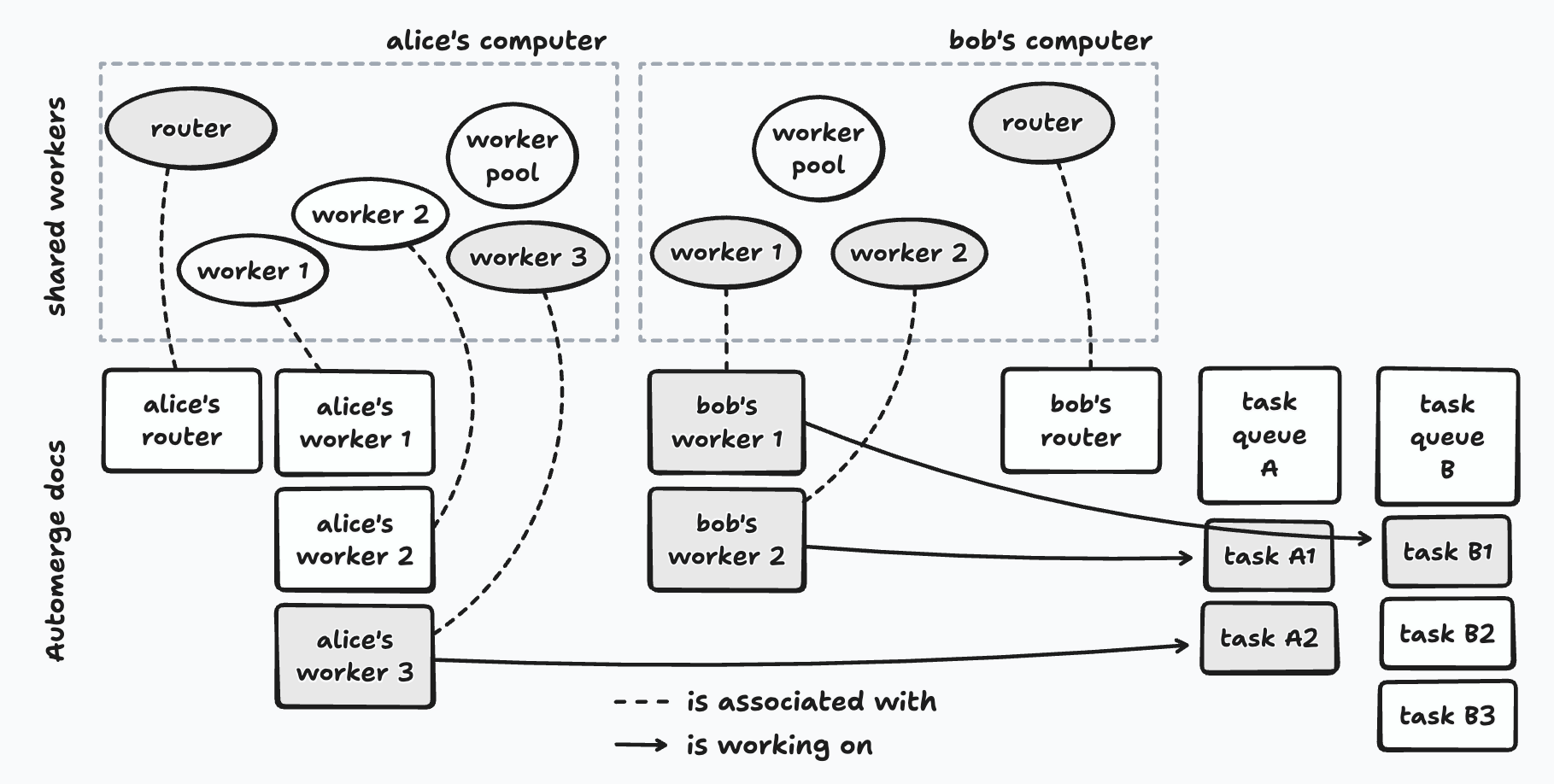
This article explores the implementation details of a local-first task framework designed for distributed collaboration, using Automerge and Web SharedWorkers. It details the cast of characters—tasks, task queues, workers, and task routers—and explains how coordination and fault tolerance are handled in a decentralized environment. The system relies on deterministic SharedWorkers and ephemeral messaging for communication without central infrastructure. It also introduces a takeover protocol using heartbeat signals to manage router failures and network partitions seamlessly.
Key Takeaways
- Tasks and their execution histories are stored in Automerge documents, utilizing CRDTs for state synchronization.
- SharedWorkers are instantiated deterministically via a worker pool proxy to maintain separate memory spaces and threads of execution.
- The takeover protocol uses heartbeat monitoring over Automerge documents to elect new active routers when nodes go offline, prioritizing eventual execution over strict exactly-once guarantees.
Why it matters
Understanding local-first architectures and CRDT-backed coordination is vital for modern software engineers building resilient, offline-capable distributed applications without heavy centralized server dependencies.
Conversation 0
Be the first to share your perspective.