
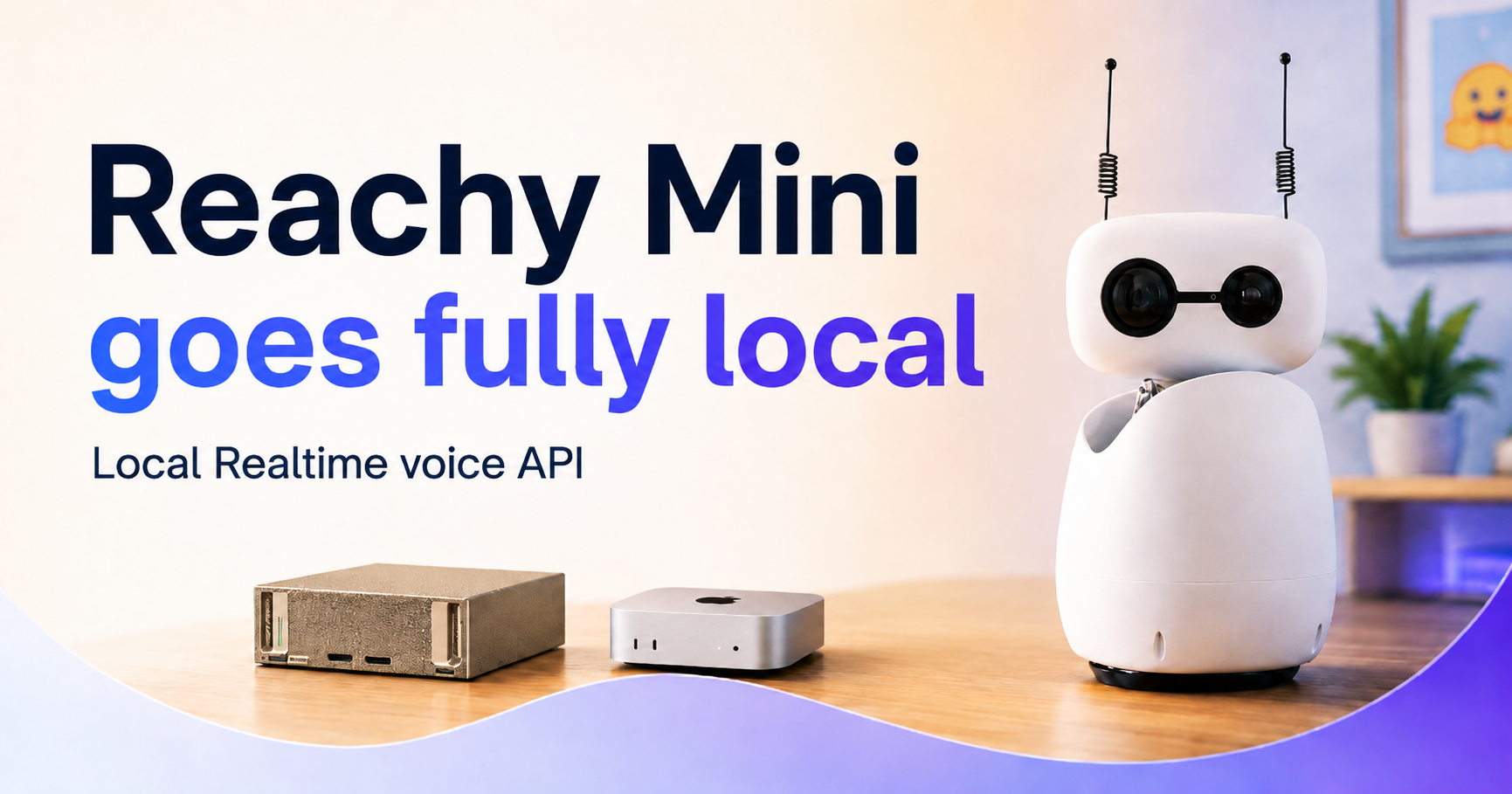
Reachy Mini goes fully local: Running an open-source speech-to-speech voice pipeline
AI Summary
A guide on running a fully local, open-source speech-to-speech voice pipeline for the Reachy Mini robot using a cascaded VAD -> STT -> LLM -> TTS architecture. It utilizes tools like llama.cpp, Silero VAD, Parakeet-TDT, and Qwen3-TTS to eliminate cloud dependencies, ensure user privacy, and avoid API costs.
Key Takeaways
- The speech stack uses a cascaded VAD -> STT -> LLM -> TTS pipeline exposing a Realtime API-compatible WebSocket server.
- Recommended local components include llama.cpp with Gemma 4, Silero VAD, Parakeet-TDT 0.6B v3 STT, and Qwen3-TTS.
- The architecture allows decoupling the LLM to run via external inference engines supporting the Responses API protocol, such as vLLM or MLX.
Why it matters
Running voice pipelines locally reduces latency, eliminates per-minute cloud API costs, and guarantees data privacy by keeping audio processing entirely on local hardware.
Conversation 0
Be the first to share your perspective.